
How do artists respond to environmental problems? Do we make images to illustrate “Disappearing Man” or “Man-made rubbish”,


or, as Mondrian said, use abstraction to escape the horrors of the world?
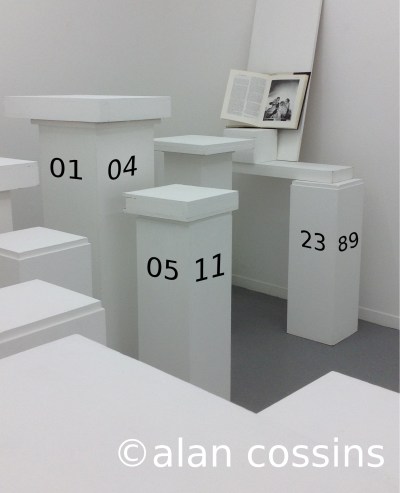
In this image, the idea of plinths, the three-dimensional embodiment of Mondrian’s squares and rectangles, gathering to venerate him, appealed to me, as did the idea of escaping the problems of the real world by creating a whimsical one.

So how much is a Mondrian painting worth? We always ask the price of a work of art (another use of number) but in the case of the illustration in the book, Mondrian painted two versions of the work. One version is worth millions, because it has been sold on the open market more than once, the other is very affordable as a print, the price of which is shown in the photograph. The plinths are worshipping the affordable one.
You might like to Google what happened in Modriaan’s life in 1912 to find out why the plinths find this of interest.

In this whimsical world, plinths also understand irony. They are seen here admiring an illustration of the work of another artist. The unknown artist was photographed by Cecil Beaton. The artist and his wife are holding a piece of the artist’s own work, with a very appropriate title. Although this is not in the “Puzzles” section you might like to guess whose work the plinths are looking at. The numbers may help.
Mathematicians can also escape the world through their “art”. In this case using natural materials to produce repetitive patterns, one of which is a “Pythagorean Tree” and the other is a “Pythagorean Spiral”
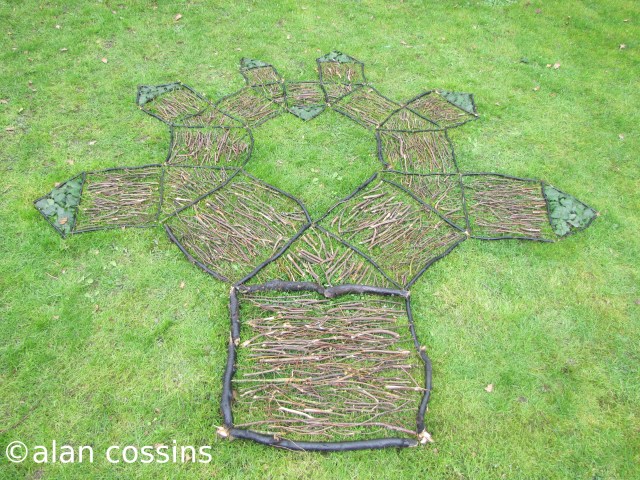
Pythagorean Tree
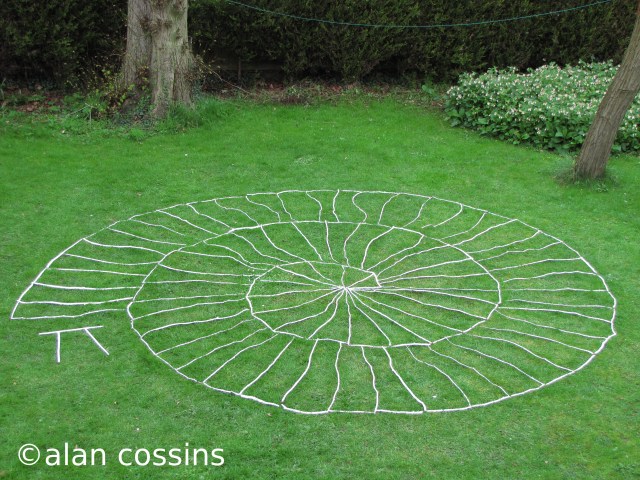
Snail Pi
 alancossinsART