
The Fibonacci series is an important one found in nature. Many plants, animal populations and seeds, develop in line with the sequence:
1, 1, 2, 3, 5, 8, 13, 21, 34, 55, 89, 144 …
The key element is that there are two numbers to start the sequence off. These are added together to get the third, then the second and third are added to get the fourth, third and fourth to get the fifth, fourth and fifth to get the sixth, and so on. Artists have been fascinated by this sequence for a long time, for example, Richard Long has completed one of his walks that followed this sequence.
As it occurs in nature I thought it would be interesting to make an ephemeral piece using natural materials, in this case leaves, to illustrate the way that the sequence progresses and the patterns that you can make.

Fibonacci Pattern
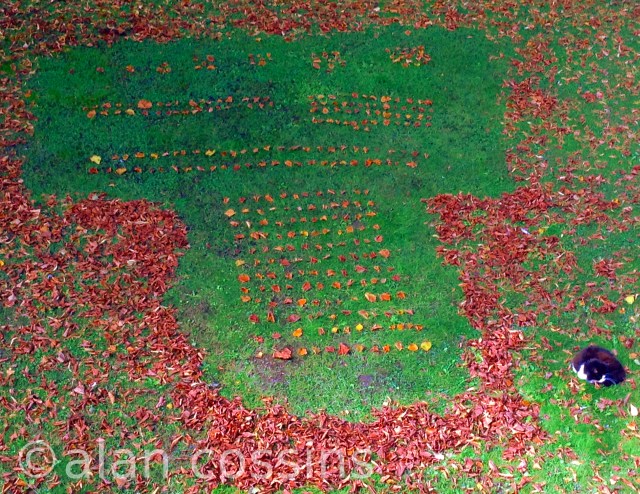
Fibonacci Face
The Fibonacci sequence also produces a spiral. First extend the structure of the sequence to that of a 1-by-1 square, then another 1-by-1 square, then a 2-by-2 square, then a 3-by-3, then 5-by-5, then 8-by-8 and so on. The length of side of each additional square is made by adding the previous two. The opposite corners are now joined together.
This spiral started with a 1cm by 1cm square, but soon grows to be huge. In fact, it was so large that it would have filled one of the walls in the gallery so I had to photograph the final image to reduce it to A3 size.
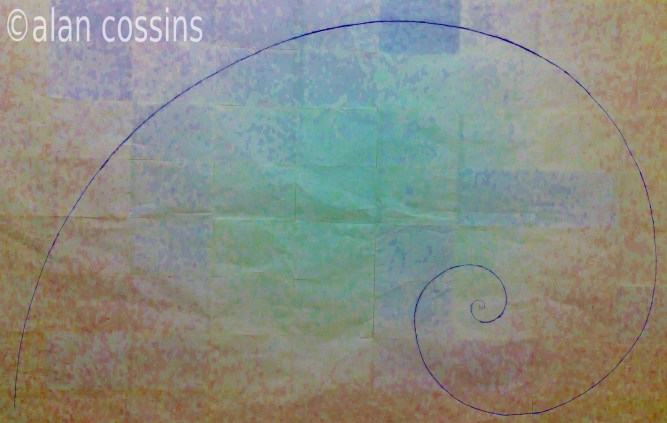
Fibonacci Spiral
Then I transported the spiral out to the beach to watch it grow.
When it is complete, the ratio of the length of the spiral (55 feet) to its width (34 feet), demonstrates the Golden Ratio (1.618), which is very pleasing to the eye and found in many famous drawings and paintings.
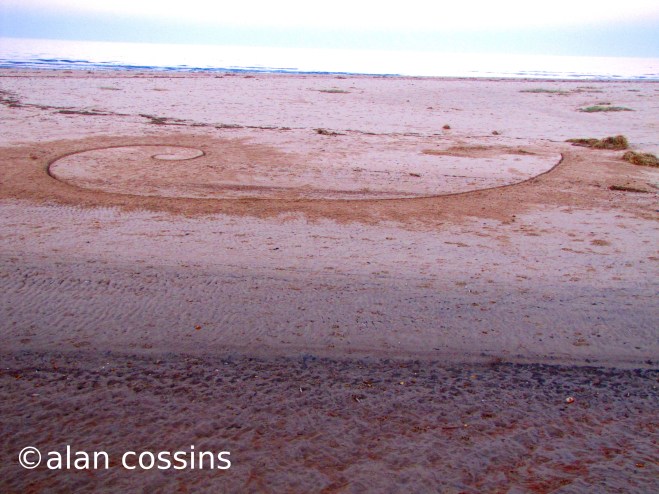
Fibonacci Spiral: Golden Completion
 alancossinsART