
Mathematics, and particularly geometry, assumes a perfect environment in which its conclusions hold true. For example, in the mathematical world geometric lines do not have dimension but in the real world the dimensionality of the line puts the drawing slightly out. I tried to compensate for this by drawing large figures on the beach, where slight imperfections remain hidden.
I used this approach to draw Napoleon’s theorem. Napoleon was, apparently, an accomplished geometer and entertained both Fourier and Laplace, two of the leading mathematicians of the day, at his home, hence the ‘echo’ in the title of the image below. His theorem states that for any triangle, if you construct an equilateral triangle on each of its sides and then find the centroid of each equilateral triangle, the triangle formed by connecting these centroids is also equilateral.
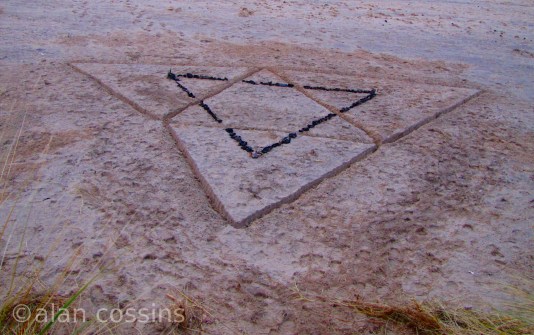
Napoleon at Ho(l)me
In fact, the black “dots” used in the beach drawing raise some important issues, because they are nodules of oil waste discharged into the sea. The waste picks up sand and detritus and gets washed up on the beach. Here the sun hardens it off on the outside so that the nodules look like charcoal nuggets. Napoleon betrayed the Revolution and oil waste has polluted the drawing. The nodules may look nice but they are deceptive.
This introduces a new theme, namely, the way that mathematics and numbers can provide hard evidence of things that we may find dangerous if we look beyond the surface. For example, we have a problem with cars, we know that cars cause pollution, but we have become dependent on them.
The next image, O3, sums up for me many of the complexities of environmental issues.
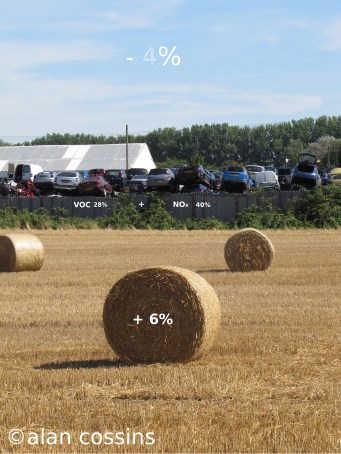
O-three
O3 is the chemical label for ozone, which in the upper atmosphere is beneficial, because it prevents harmful radiation penetrating to ground level where the sun’s rays can cause skin cancer. Consequently, its depletion is harmful. However, there is a debate amongst scientists about the current figure for ozone depletion. Some think that, as a result of worldwide regulation of harmful gases and chemicals, the average depletion is now about -3.5%, others suggest a figure of -6%. So what can we conclude? Well, there is definitely a decline in ozone in the upper atmosphere, but the actual figure is fuzzy, as is the – 4% in the image. Meanwhile, at ground level ozone is harmful to humans, where it increases the chance of respiratory illnesses, like asthma. Ground-level ozone is formed when emissions of Nitrous Oxides (NOx) and Non-Methane Volatile Organic Compounds (VOC) react together. On–road vehicles contribute 28% of the VOC and 40% of the Nox at ground level. A report from the Royal Society warned that background levels of ozone have been growing by +6% a decade since the 1980s and according to the Royal Society, 1,582 deaths in the UK in 2003 were attributed to ozone’s effects on people’s respiratory systems.
The next image presents a problem that we have with cars regardless of the power source of the engine. We have to dispose of them when they are damaged, but scrapyards are not viewed as “recycling centres for cars”, they are dumping grounds for insurance failures. The image reinforces the idea that we are familiar with the harvesting of crops but not with the harvesting of components from cars.
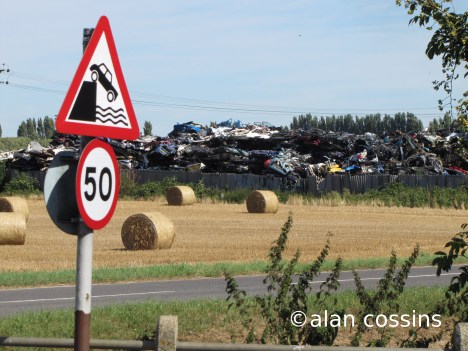
Harvesting at 52.6532° N
 alancossinsART