
The theme for Cley in 2019 was “Borderline”.
My proposal had three interpretations of the theme:
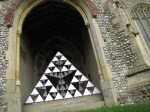
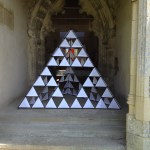
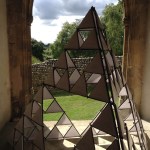
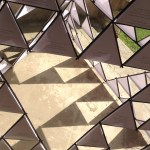
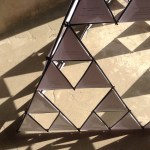
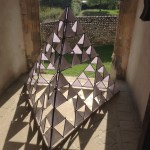
- the borderline between mathematics and art (it was a bamboo framework of Sierpinski’s Gasket),
- it identified the borderline of negative space depicted by the edges of Sierpinski’s Gasket
- it explored the borderline between war and peace by presenting information in panels that showed that wars continued after the Armistice was signed on November 11, 1918.
The inspiration for the panels came from a scene at the end of the film “Oh! What a lovely war” when the last man killed at the end of the First World War is beiing directed to lie down with his comrades. They then all become white crosses. It is very poignant, but gives the impression that the war did come to a sudden conclusion. In fact, in some cases the Armistice was a call to arms for new nationalist uprisings in the crumbling Ottoman Empire, the former Russian Empire and Austria-Hungary. Moreover, Woodrow Wilson’s principle of self-determination of national groups, inspired rebellion in many different parts of the world. In all, there were 81 panels in the sculpture that commemorated a battle, conflict or rebellion that took place immediately after peace was supposedly declared.

 alancossinsART